Searching for Contacts
In addition to searching for contacts by name or phone number, you can enter queries in the search bar on your contacts tab or in the 'Start Flow' dialog to find contacts based on the values in their contact fields.
Queries
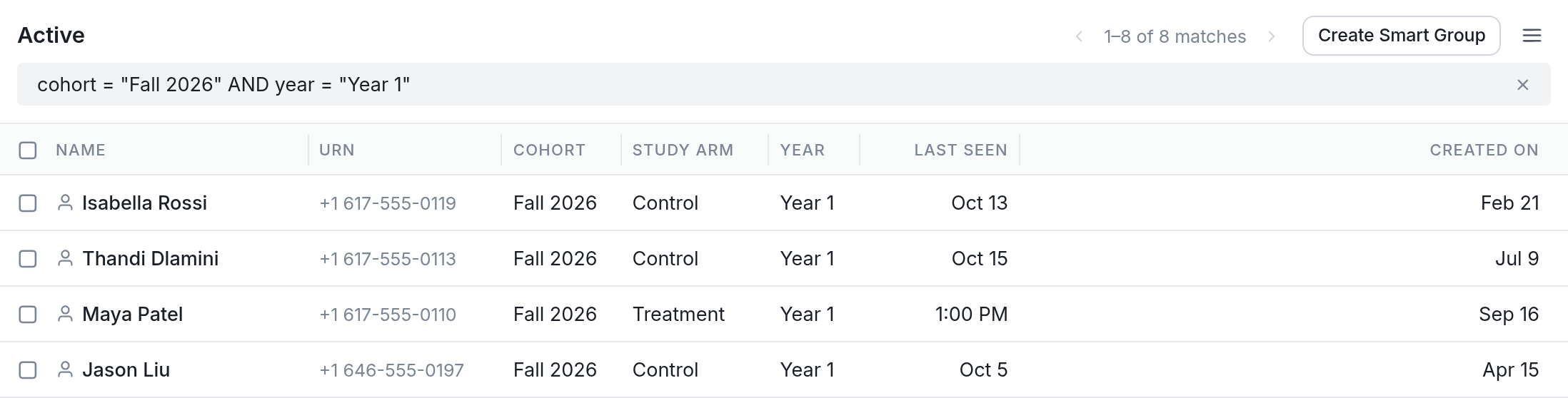
A query works on all the contact fields in your account. Fields and values are not case sensitive within a query. For example, cohort = "Fall 2026" AND year = "Year 1" finds contacts whose Cohort field is "Fall 2026" and whose Year field is "Year 1":

Operators
To find contacts whose contact field matches a value, use equal =. Example: hair = "blonde"
To search between two numbers, use greater than or equal to >= and less than or equal to <=. Example: age >= "18" AND age <= "30"
To search for not equal, use !=. Example: student_id != 001
For contact fields with two or more words in their names, replace the spaces with underscores, e.g. id_number = 409328 |
For names and URNs (phone numbers), you can use the ~ or has operator to search for a substring, e.g. tel ~ "779"
To find empty fields, use "". For example, fields.gender = "" finds contacts whose Gender field is empty. On the other hand, != "" finds fields that are not empty. For example, fields.gender != "" finds contacts whose Gender field is set to something.
Statements
Use OR statements to match any of two or more contact field values, and AND statements to filter contacts by more than one contact field.
For example, city = "Oakland" or city = "Berkeley" returns only those contacts whose City field contains "Oakland" or "Berkeley", and city = "Oakland" and gender = "Male" returns only those contacts whose City field contains "Oakland" and whose Gender field contains "Male".
tel has "123" returns only those contacts whose phone number contains "123".
name has "Be" returns only those contacts whose Name field contains "Be".
Field Types
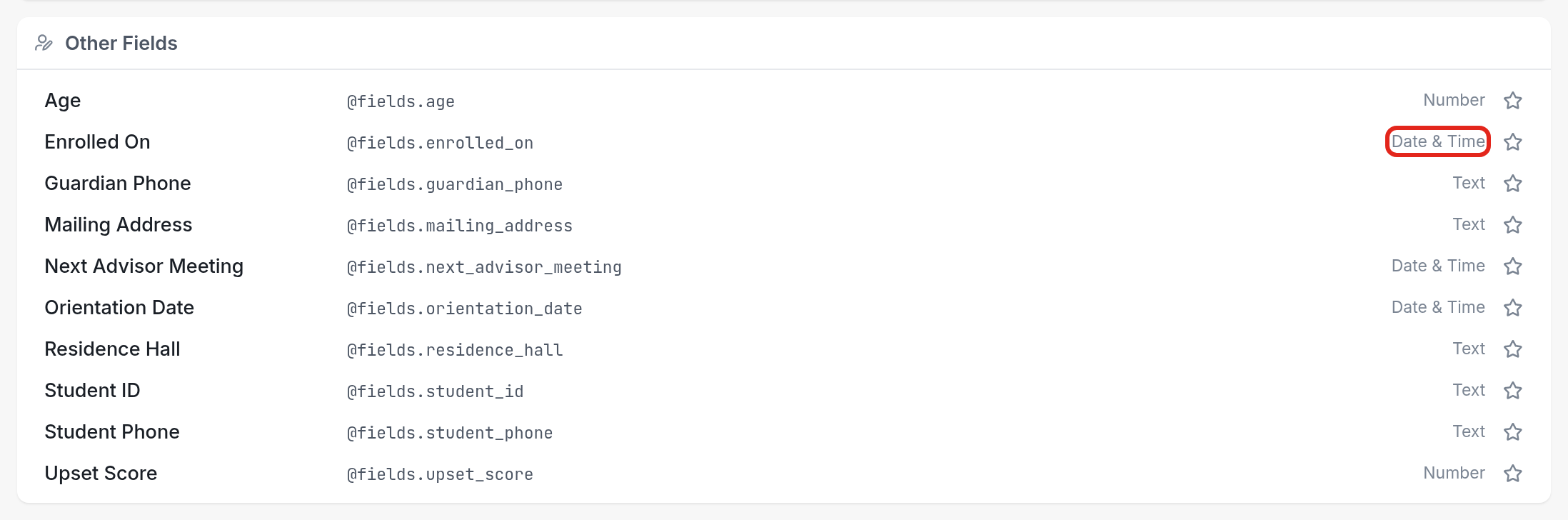
Text values containing multiple words must be enclosed in quotation marks, e.g. city = "san francisco", while operators like >= only work with Number and Date & Time values. You can see each field's type on the contact fields page:
Smart Groups
Groups created from queries are called Smart Groups. Smart groups, previously called dynamic groups, keep collecting contacts who match the query that created them.
Creating a Smart Group
Once you enter a query, the platform returns the contacts who match it and shows the number of matches at the top right, such as 1–8 of 8 matches. To save these results as a new group, click Create Smart Group at the top right:
Once a smart group is saved, any new contacts that match the query are automatically added to it.